Metabolism, Aging and Disease
Inflammation, Immunobiology & Translational Pharmacology
Inflammatory signaling and immunomodulation
Immunopharmacology
Neuroinflammation and microglial immunobiology
Dendritic cell-based cancer immunotherapy
Biomaterials and artificial antigen-presenting cells
Natural bioactive compounds
Skin inflammation and regenerative medicine
New Approach Methodologies (NAMs)

Research lines
Inflammatory Signaling and Innate Immunity
Cancer Immunotherapy and Biomaterial-Based Immunomodulation
Natural Products and Translational Pharmacology
New Approach Methodologies (NAMs)
Overview
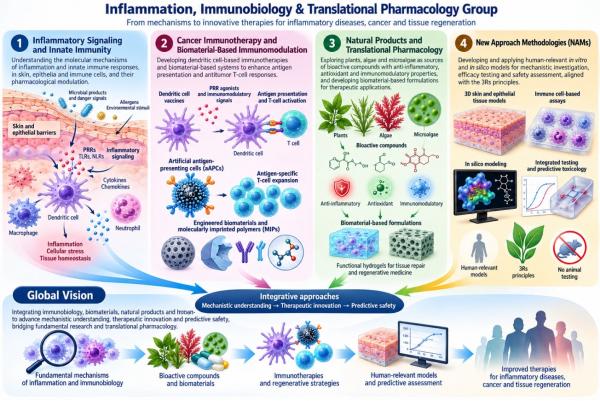
Our group investigates the molecular mechanisms of inflammatory signaling and innate immunity, with a particular focus on their pharmacological modulation and therapeutic potential. Our research encompasses inflammatory responses in peripheral tissues and the central nervous system, including microglial activation and neuroinflammation. We develop cancer immunotherapies based on dendritic cells and biomaterial-based artificial antigen-presenting systems, while exploring engineered biomaterials, including molecularly imprinted polymers and functional hydrogels, for biomedical and regenerative applications. We also investigate natural resources, particularly plants, algae and microalgae, as sources of bioactive compounds with anti-inflammatory, antioxidant and immunomodulatory properties. By integrating New Approach Methodologies (NAMs), including human-relevant cellular and 3D tissue models, we advance mechanistic understanding, therapeutic innovation and predictive safety assessment, bridging fundamental research, immunobiology, biomaterials engineering and translational pharmacology.
The major research lines of our group are:
- Inflammatory Signaling and Innate Immunity
1. Investigation of the molecular mechanisms underlying inflammatory signaling and innate immune responses in skin, epithelial tissues, peripheral immune cells and central nervous system-resident immune cells, particularly microglia and their potential as targets for pharmacological intervention.
2. Investigation of the interplay between inflammatory responses, cellular stress and tissue homeostasis, with particular emphasis on immunomodulatory strategies aimed at controlling peripheral and neuroinflammatory processes. - Cancer Immunotherapy and Biomaterial-Based Immunomodulation
1. Development and optimization of dendritic cell-based cancer immunotherapies, including dendritic cell vaccines and strategies to enhance antigen presentation and antitumor T-cell responses.
2. Investigation of pattern recognition receptor (PRR) agonists and other immunomodulatory signals to control dendritic cell activation and improve the efficacy of cancer immunotherapy.
3. Development of biomaterial-based artificial antigen-presenting cells (aAPCs) that mimic key dendritic cell functions to promote antigen-specific T-cell activation and expansion.
4. Exploration of engineered biomaterials and molecularly imprinted polymers (MIPs), including synthetic antibody-like recognition systems, for selective molecular recognition and potential biomedical applications. - Natural Products and Translational Pharmacology
1. Investigation of the bioactivity and pharmacological properties of natural resources, including plants, algae and microalgae, with particular emphasis on anti-inflammatory, antioxidant and immunomodulatory compounds.
2. Characterization of the molecular mechanisms underlying the biological effects of natural compounds and evaluation of their potential as therapeutic agents or immunomodulatory adjuvants.
3. Development and evaluation of biomaterial-based formulations, including functional hydrogels, for tissue repair, regenerative medicine and the modulation of local inflammatory responses. - New Approach Methodologies (NAMs)
1. Development and application of human-relevant in vitro and in silico models, including 3D skin and epithelial tissue models, immune cell-based assays and cellular models of neuroinflammation, for mechanistic investigation, efficacy testing and safety assessment.
2. Implementation of integrated experimental approaches to investigate inflammatory and immune responses, evaluate bioactive compounds and biomaterials, and support predictive toxicology.
3. Promotion of scientifically robust and human-relevant methodologies aligned with the 3Rs principles, supporting the translation of experimental findings into biomedical and therapeutic applications.
Team






Publications
Information about journal articles, updated at 23-11-2026, from platform CIÊNCIAVITAE.
5 out of 412 Publications
Past R&D Projects